
Key Takeaways
- Basic fields (Text Input, Email, Text Area, Number, URL, Password, Dropdown, Checkbox, Radio Buttons, Multiple Choice, Date, Time) cover most forms and are free on every plan.
- Advanced fields (File Upload, Phone Number, Country, Image Upload, Range Slider, Color Picker, Button Option, Rating, NPS, E-Signature, Voice Recording, Audio Upload, Video Upload, URL Source Collector) need Pro or Scale.
- That's 26 field types total, 12 Basic and 14 Advanced.
- Pick a field type based on what happens when someone answers wrong or skips it, not just what looks closest to the data you want.
- Attribution tracking (URL Source Collector) is a field type most people evaluating a form never think to check for.
Overview
Most form field types are easy to add and easy to pick wrong. A free-text box where a dropdown belongs, a checkbox with no clear consent language, a phone field with no country context, these are small choices that add friction one field at a time for whoever's filling out the form.
This covers Framer form field types by use case rather than as a flat catalog: what each cluster is for, what a weak implementation looks like generically, and how Forms Plugin's version works. Every generic point holds regardless of which form tool you're using. The Forms Plugin specifics are there because it's the tool we build, not because the advice depends on it.
Quick Answer
- Basic fields (Text Input, Email, Text Area, Number, URL, Password, Dropdown, Checkbox, Radio Buttons, Multiple Choice, Date, Time) cover most forms and are free on every plan.
- Advanced fields (File Upload, Phone Number, Country, Image Upload, Range Slider, Color Picker, Button Option, Rating, NPS, E-Signature, Voice Recording, Audio Upload, Video Upload, URL Source Collector) need Pro or Scale.
- That's 26 field types total: 12 Basic, 14 Advanced.
- Pick a field type based on what happens when someone answers wrong or skips it, not just what looks closest to the data you want.
- Attribution tracking (URL Source Collector) is a field type most people evaluating a form never think to check for.
How many field types does Forms Plugin actually have?
26, split into two tiers. 12 Basic fields are available on every plan: Text Input, Email, Text Area, Number, URL, Password, Dropdown, Checkbox, Radio Buttons, Multiple Choice, Date, Time. 14 Advanced fields require Pro or Scale: File Upload, Phone Number, Country, Image Upload, Range Slider, Color Picker, Button Option, Rating, Promoter Score/NPS, E-Signature, Voice Recording, Audio Upload, Video Upload, and URL Source Collector.
How do you collect contact info without frustrating people?
A contact field's whole job is capturing something correctly on the first try, because a bounced email or an unreachable phone number is worse than no submission at all. The common failure mode is treating every contact field as a plain text box: no format check on email, no country context on phone, no protocol requirement on a URL. A visitor from outside your home country hits a phone field built for one country's number format and either abandons the form or submits something that never gets called back.
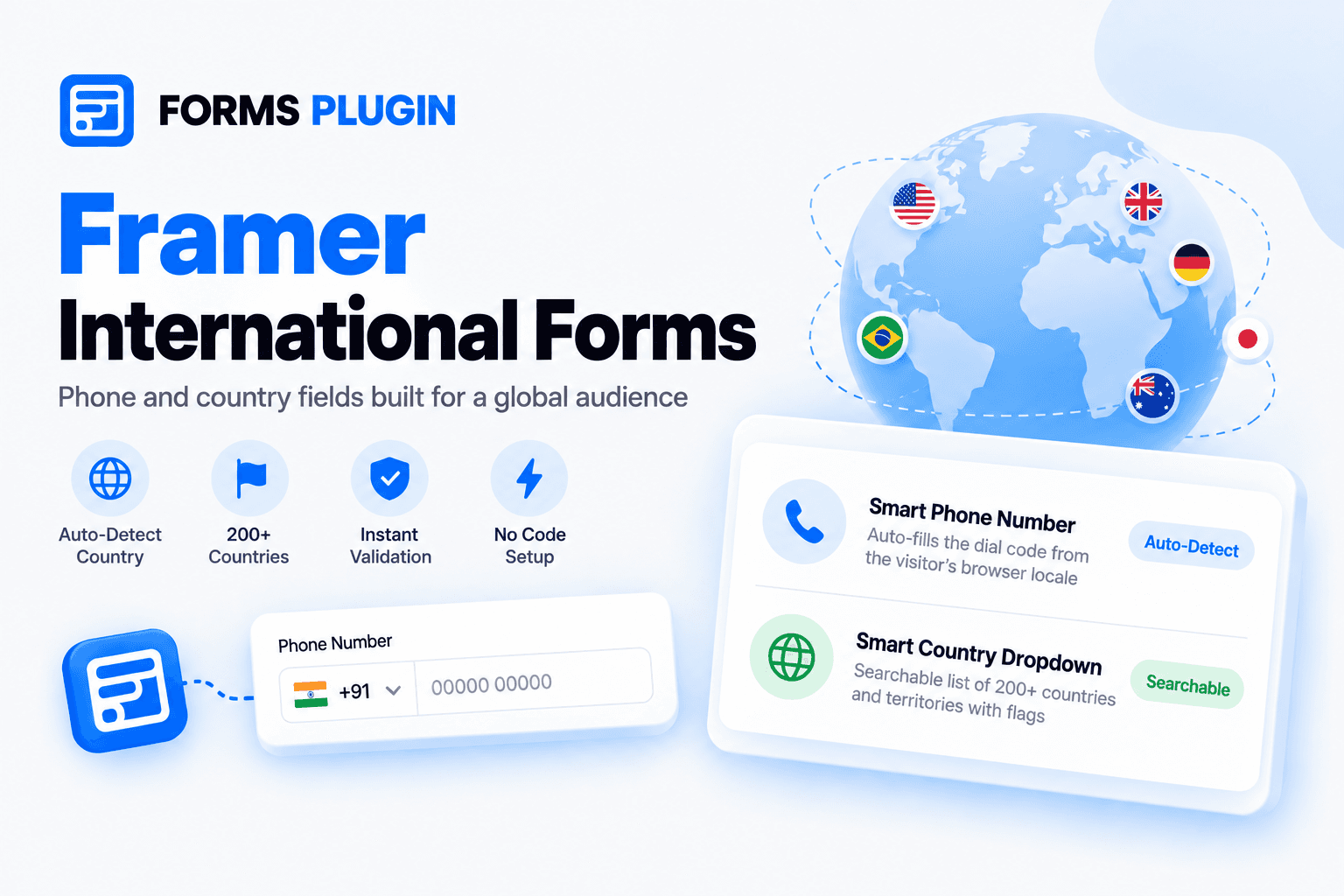
Text Input, Email, and URL cover the basics and need less explaining, most form tools get those right. Phone and country context is where implementations diverge more. Forms Plugin's international forms fields pair a Smart Phone Number field that detects the visitor's country from browser locale and validates against that country's number format, with a searchable Smart Country Dropdown covering 200+ countries and territories. Both are Advanced fields on Pro and Scale. Our international forms guide covers how the detection and validation actually behave, and the field validation post covers the broader validation options (blocked domains, pattern matching, character limits) that apply across contact fields generally, not just phone and country.
What makes a good choice field: dropdown, radio, checkbox, or button?
A choice field's job is narrowing an answer to one of a known set, and the wrong format makes that harder instead of easier. A dropdown with 3 options wastes a click a set of radio buttons would save. A radio group with 20 options makes someone scroll and hunt instead of type-searching. A checkbox used for consent with no clear label attached is a compliance problem on top of a UX one: pre-ticked boxes don't count as valid consent under GDPR, which requires an active, unambiguous opt-in, not silence or a default state.
Forms Plugin covers this range with Dropdown, Radio Buttons, Checkbox, Multiple Choice, and Button Option (a styled button-style selector), all Basic-tier except Button Option. Our dropdown field guide covers when a dropdown beats radio buttons and how search behaves once a list gets long, worth reading before defaulting to a dropdown for every choice field.
How should dates and scheduling fields behave?
A date field that accepts any typed string invites exactly the format confusion you'd expect, 03/04 means a different date depending on which country someone's in. A dedicated date field with a real calendar picker removes that ambiguity, and a separate time field matters whenever scheduling, not just a date, is the actual data you need.
Forms Plugin's Date and Time fields are both Basic-tier, free on every plan. Our date picker guide covers the field in more depth, including how it pairs with conditional logic for booking-style forms.
How do you collect feedback that's actually useful?
Feedback fields fail in a specific way: a 5-point scale with no labels forces a guess about what each number means, and a single free-text "any comments?" box gets skipped by most people who'd have answered a structured question. The Net Promoter Score format, a 0-10 likelihood-to-recommend scale, exists specifically because Bain's research found that scale produced a cleaner behavioral split between loyal and at-risk customers than vaguer satisfaction scales did.
Forms Plugin's Rating, Promoter Score (NPS), and Range Slider fields are Advanced-tier, available on Pro and Scale. Our NPS rating guide covers how to build a feedback form that actually gets answered rather than skipped.
What's the right way to collect files, signatures, and media?
A file upload field with no type or size restriction is an invitation for the wrong file format or a file too large to process. An e-signature requirement bolted on through a separate tool like DocuSign adds a step a visitor has to leave your site to complete, which is exactly the kind of drop-off point that kills a form's completion rate.
Forms Plugin's File Upload field accepts documents, images, audio, and video, capped at 50MB per file on Pro and Scale. Our file upload guide covers setup and recommended size limits for different file types. The E-Signature field lets a visitor draw a signature with a finger or mouse directly inside the form, timestamped and stored with the submission, no external service needed, covered in the e-signature guide. Voice Recording, Audio Upload, and Video Upload round out this group and don't have dedicated posts yet: Voice Recording captures audio directly in the browser without a separate app, while Audio Upload and Video Upload accept pre-recorded files, useful for testimonial requests, audio consent statements, or video applications where a visitor already has the file ready rather than recording on the spot. All of these are Advanced fields on Pro and Scale.
Which hidden field types are easy to miss?
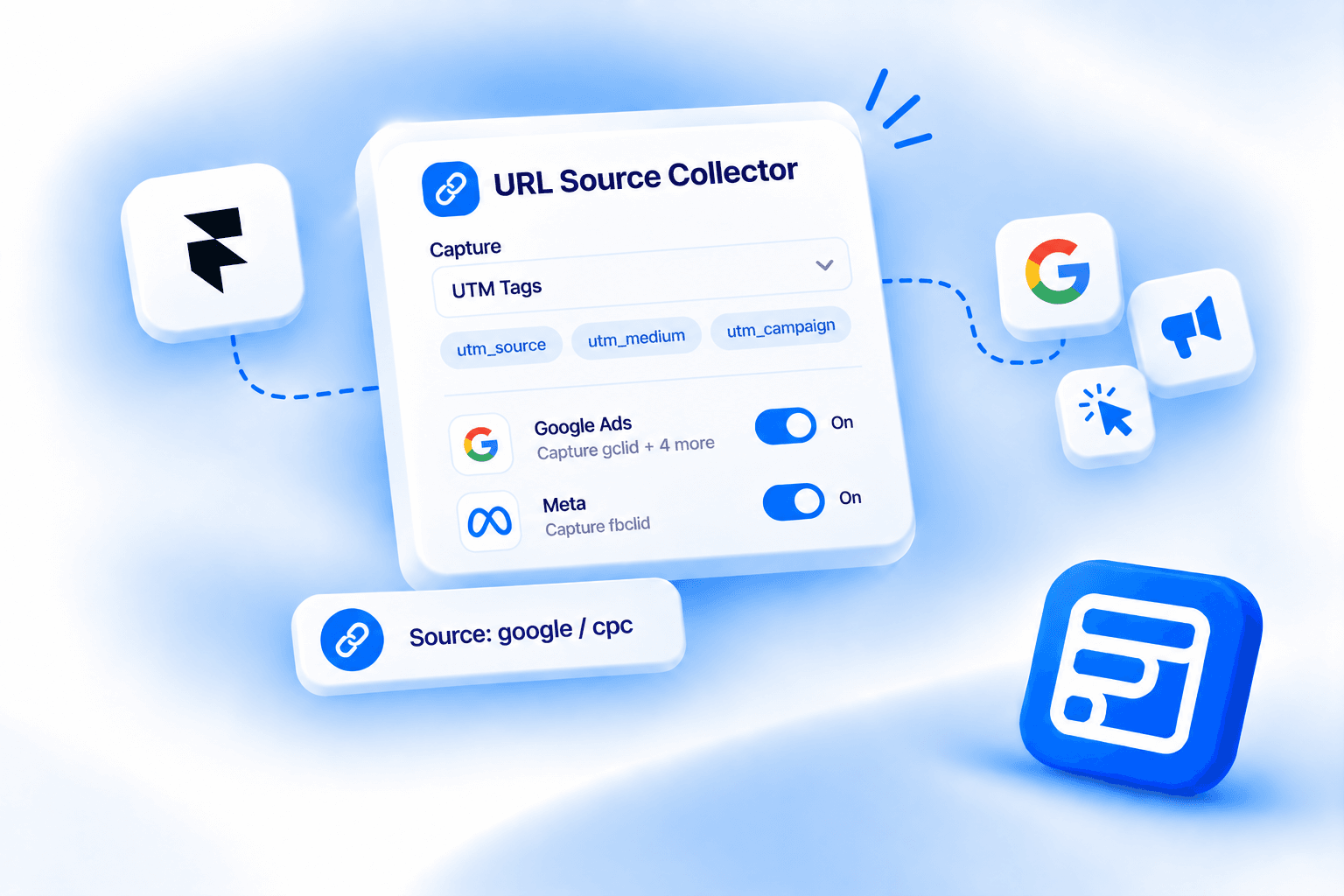
Two Advanced fields do their job without ever asking a visitor a question, which is exactly why they're easy to overlook when scanning a field list. Color Picker lets a visitor choose a color value directly, useful for product customization requests or design-preference forms where "pick a color" is a literal part of what you're collecting. URL Source Collector captures attribution data, UTM parameters, referrer, and ad-platform click IDs, without showing the visitor a field at all.
Most people evaluating field types check for the ones they'll type into and skip past the ones that work silently. That's the whole reason URL Source Collector is worth flagging specifically: it's a 5-mode field covering UTM tags, current URL, referrer URL, a named URL parameter, or a static custom value, plus ad-platform click ID capture for Google, Meta, Microsoft, LinkedIn, TikTok, and X. Our full breakdown covers all 5 modes. Both fields are Advanced-tier, Pro and Scale.
Frequently asked questions
Do I need Pro or Scale to use any advanced field type at all?
Yes. All 14 Advanced fields, including Phone Number, Country, File Upload, E-Signature, and URL Source Collector, require Pro or Scale. The 12 Basic fields work on the free Basic plan.
Should every form use as many field types as possible?
No. More field types available doesn't mean more fields belong on any one form. Each field you add is one more thing asking for a visitor's attention, match the field to the specific data you actually need.
Is a checkbox enough for GDPR consent?
A checkbox can work, but only if it's unchecked by default and the visitor actively checks it themselves. A pre-ticked box doesn't count as valid consent.
What's the difference between Multiple Choice and Radio Buttons?
Both present a fixed set of options, the practical difference in most form builders is styling and whether multiple selections are allowed versus exactly one, check which behavior a specific field type actually implements before assuming.
Bottom line
The field type matters less on its own than whether it matches what happens after someone answers it: a phone field that validates for their actual country, a consent checkbox that requires a real click, a file upload with sane size limits, a feedback scale with real labels behind the numbers. Forms Plugin covers 26 field types across Basic and Advanced tiers, with the attribution and international fields being the ones most evaluations skip past entirely. Start with what your form actually needs to collect, then match the field type to that, not the other way around.
Ready to build smarter Framer forms?
Forms Plugin gives you everything covered in this article - natively, inside Framer.
Get Forms Plugin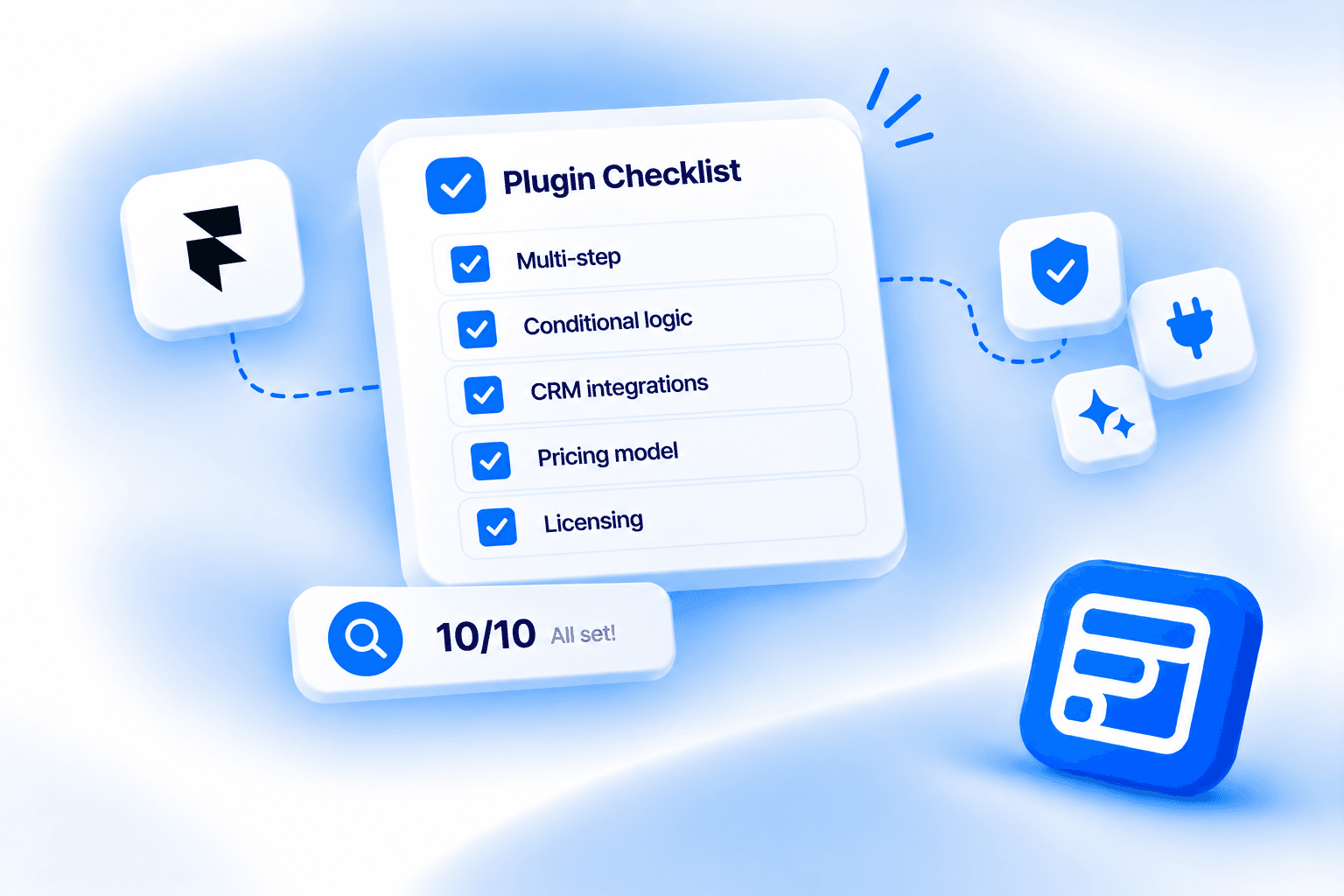
 Get this Plugin