Key Takeaways
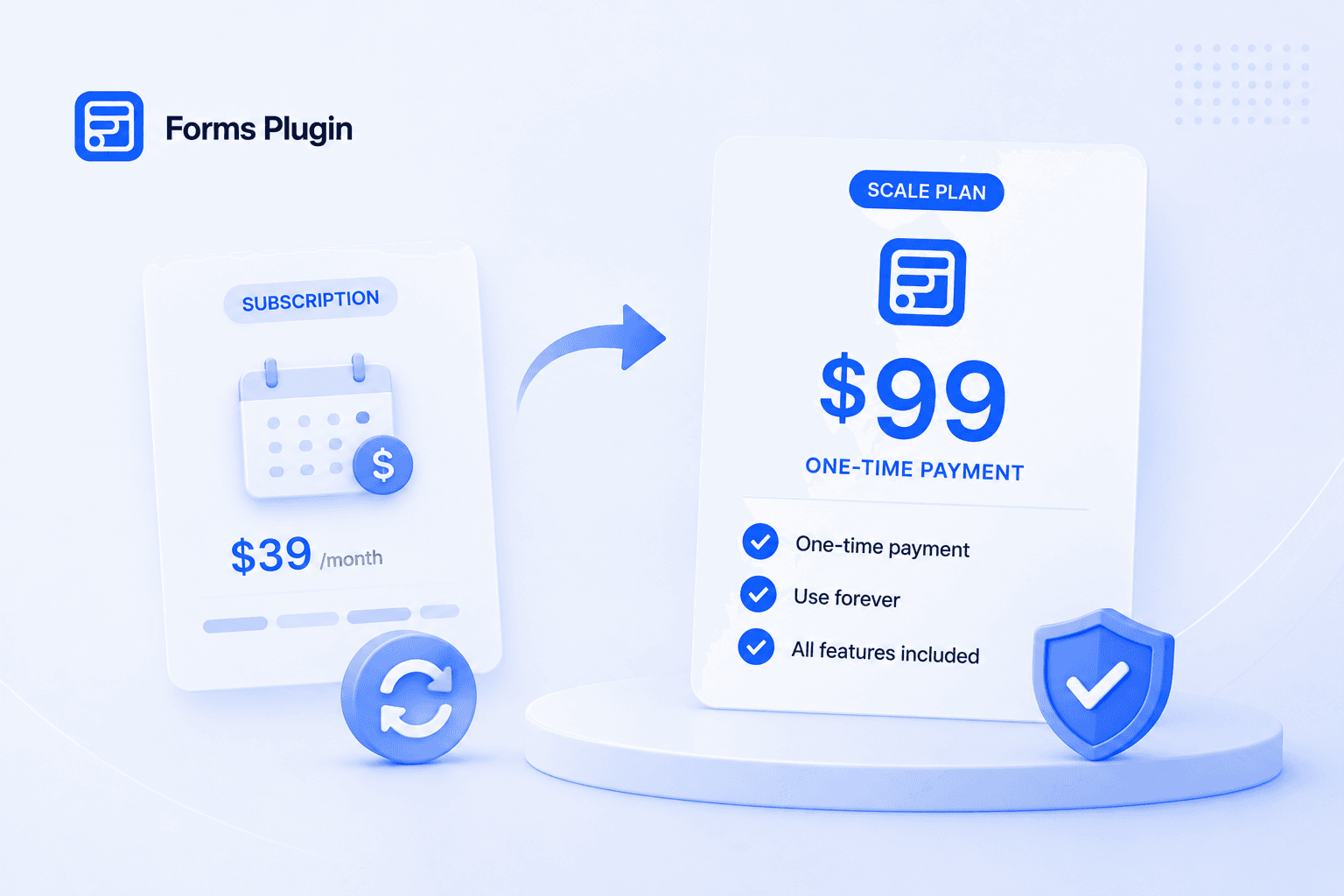
- Lifetime pricing means one upfront payment and no recurring fees, ever, in exchange for a bigger bill on day one.
- Subscription pricing means a smaller entry cost, but it repeats every month for as long as you keep using the tool.
- Which one is cheaper depends on how long you'll use the tool and whether you need subscription-only features.
- In the vendor examples compared here, a one-time fee breaks even against a typical subscription within 4 to 5 months.
Overview
Comparing lifetime pricing vs subscription costs for a form builder mostly comes down to time horizon. A subscription can seem inexpensive in month one and expensive by year two. A one-time fee can seem expensive upfront until you run the math out over the time you'll actually use the tool.
Most pricing pages are built to make the monthly price seem smaller than it really is over time. $24 or $39 a month reads as a rounding error next to a $119 one-time fee, until you multiply it out over your real usage window. Neither approach is wrong on its face, they're answering different questions: a subscription answers "what does this cost me this month," a one-time fee answers "what does this cost me, period."
Quick Answer
- Lifetime pricing means one upfront payment and no recurring fees, ever, in exchange for a bigger bill on day one
- Subscription pricing means a smaller entry cost, but it repeats every month for as long as you keep using the tool
- Which one is actually cheaper depends on how long you'll use the tool and whether you need features that only exist on a subscription tier
- This guide compares both models in general, then uses real form builders, Typeform, Tally, and Forms Plugin, as concrete examples
What is lifetime pricing?
Lifetime pricing, sometimes called a one-time fee or a perpetual license, means you pay once and keep access indefinitely. There's no recurring charge tied to continued use, no renewal date, and no risk of the tool suddenly locking you out because a card expired.
The trade-off is upfront cost. A lifetime license usually costs more than a single month of the equivalent subscription tier, sometimes a lot more, because that one payment is meant to cover years of use rather than one billing cycle.
Lifetime pricing is more common with smaller, focused tools, plugins, and one-off utilities than with large platforms, since it doesn't generate the ongoing revenue that funds a big engineering team or a large integration marketplace.
What is subscription pricing?
Subscription pricing charges a recurring fee, usually monthly or annual, for as long as you use the product. Stop paying and access typically ends immediately, or drops to a heavily limited free tier.
The appeal is a low entry cost. Signing up for $24 or $39 a month is an easy decision compared to a $119 lump sum, even if the subscription ends up costing more over time. Subscriptions also tend to bundle in ongoing feature development, frequent updates, and, at higher tiers, capabilities a smaller one-time-fee tool may never build, things like AI-driven enrichment or enterprise-grade analytics.
The trade-off is that the fee never stops. It's due every billing cycle regardless of whether your usage of the tool has grown, stayed flat, or shrunk.
Who should choose which?
Lifetime pricing usually makes more sense for:
- Business websites expected to stay live for a year or more.
- Agencies managing several client sites under one license.
- Long-term projects where the tool isn't going anywhere.
- Anyone who wants to avoid tracking another recurring bill.
Subscription pricing usually makes more sense for:
- Temporary campaigns and short-term projects with a defined end date.
- One-off events, like a registration form that closes in a few weeks.
- Teams that need enterprise-only features, AI response enrichment, deep CRM sync, or high-volume funnel analytics, that lifetime-priced tools typically don't build.
What do form builders actually cost over time?
Typeform's entry-level paid plan is Basic at $39/month, or $468/year if billed monthly, roughly $28/month if you commit to annual billing upfront. Tally's Pro plan is lower, at $24/month. Neither one stops billing, ever, as long as you're using the product.
Run that out to two years: Typeform Basic totals $936, Tally Pro totals $576. Three years pushes Typeform past $1,400. These aren't inflated worst-case numbers, they're the published entry-level prices for each product's lowest tier that removes core limits like branding.
| Tool | Entry paid tier | Monthly | 1 year | 2 years | 3 years |
|---|---|---|---|---|---|
| Typeform Basic | $39/mo (monthly billing) | $39 | $468 | $936 | $1,404 |
| Tally Pro | $24/mo | $24 | $288 | $576 | $864 |
| Forms Plugin Scale | $119 one-time | $0 after purchase | $119 | $119 | $119 |
That's just the entry tiers. Typeform's Business plan runs $129/month ($1,548/year), and its Growth Flow tier is $379/month, over $2,850 a year even on annual billing. Tally's Business plan is $74/month. None of this includes add-ons, response overages, or the jump you take the moment your usage crosses a plan's response cap, which is exactly the moment a lot of subscription form tools nudge you toward the next tier up.
When does a one-time payment break even?
The break-even point is the month where cumulative subscription spend passes the one-time fee. After that point, the subscription has definitively cost more.
| Month | Typeform Basic (cumulative) | Tally Pro (cumulative) | Forms Plugin Scale (one-time) |
|---|---|---|---|
| 1 | $39 | $24 | $119 |
| 2 | $78 | $48 | $119 |
| 3 | $117 | $72 | $119 |
| 4 | $156 | $96 | $119 |
| 5 | $195 | $120 | $119 |
| 6 | $234 | $144 | $119 |
Against Typeform Basic, a $119 one-time fee breaks even by month 4, $156 in cumulative subscription spend has already passed $119. Against Tally Pro, break-even lands a bit later, by month 5, once cumulative spend crosses $119 at $120.
The short version: for a site that stays live past 4 to 5 months, the one-time fee is already the cheaper option, and the gap only widens from there.
Forms Plugin's lifetime pricing, as an example
Forms Plugin is one example of a form builder priced this way. Its Scale plan is $119, one time, for lifetime access, with a commercial license for client work included and no recurring charge ever again. The Pro plan is $99 one-time if you don't need the commercial license or multi-site support.
There's also a free Basic tier with no credit card required, which neither Typeform nor Tally offer at a genuinely usable level. Typeform's free tier caps out fast, and most no-code form tools treat their free tier mainly as a trial funnel rather than something built to stay on long-term.
For agencies specifically, the math compounds. A subscription form tool is typically priced per account, so managing five client sites on Typeform Basic means either five separate subscriptions or routing every client through one account, which raises its own ownership questions when a client relationship ends. A lifetime license that includes a commercial license and unlimited sites under one fee means the tenth client site costs the same as the first: nothing.
Hidden costs on both sides
Neither pricing model is free of costs beyond the sticker price.
Subscription hidden costs:
- Renewal price increases, list prices tend to rise over a product's lifetime, and existing subscribers aren't always grandfathered in.
- Per-seat pricing, adding teammates can multiply the monthly bill well beyond the advertised entry price.
- Usage and response limits that force an upgrade once you cross them, often at the worst possible time.
- Ongoing upgrade pressure, features get gated behind higher tiers as the product matures.
Lifetime hidden costs:
- A larger upfront payment, a real cash-flow consideration for a small team or solo freelancer.
- Some lifetime tools charge again for major version upgrades, though this varies by vendor and isn't universal.
- A smaller feature ecosystem in some cases, since recurring subscription revenue is often what funds faster feature development and a larger integration marketplace.
Decision tree: which should you pick?
- Need the tool for under 6 months? Lean subscription. A one-time fee won't have time to pay for itself in that window.
- Need enterprise-only features like AI response enrichment, advanced CRM sync, or high-volume funnel analytics? Lean subscription. Lifetime-priced tools generally don't build these.
- Otherwise? Lifetime usually wins on total cost, especially once you're past the 4 to 6 month break-even mark.
Real-world scenarios
A freelancer with one client site. A single site that stays live for a year or more clears break-even in a few months. After that, the lifetime fee is pure savings compared to what the subscription would have cost over the same stretch.
An agency managing 20 client sites. Subscription costs multiply per seat or per site: 20 sites at $24 to $39 a month each is $480 to $780 every single month just for entry-level tiers. A lifetime license that covers unlimited sites under one fee turns that into a fixed, one-time cost. At this scale the lifetime model isn't just cheaper, it's dramatically cheaper.
An event organizer needing a form for 2 months only. Here the subscription can genuinely cost less. Two months of Typeform Basic or Tally Pro ($48 to $78) comes in under a $119 one-time fee, since the project ends before break-even is reached.
Agencies managing multiple client sites tend to see subscription costs compound faster than freelancers managing a single site, since monthly fees scale per project while a one-time license stays fixed regardless of how many sites it's used on.
Subscription fatigue: a concrete example
It's a well-documented pattern beyond just form tools. Companies now run a striking number of SaaS subscriptions simultaneously, and the pattern holds at the individual tool level too.
Stack the tools a typical business site actually runs and the total adds up fast:
| Tool category | Typical monthly cost |
|---|---|
| Forms | $39 |
| Email marketing | $49 |
| Analytics | $59 |
| CRM | $89 |
| Scheduling | $16 |
| Design tool | $35 |
| Hosting | $20 |
| Total | $307/month |
A $24 or $39 monthly charge feels trivial in isolation. Stacked across the handful of tools most sites actually run, it adds up to a real recurring line item that's easy to lose track of, well over $300 a month, or roughly $3,700 a year, before accounting for any usage-based overages. A one-time fee for any one piece of that stack doesn't carry that same slow accumulation risk. What you pay once is the ceiling, not a starting point.
There's a second cost subscriptions carry that rarely shows up in a pricing comparison: what happens when you stop paying. Cancel a subscription form builder and the form on your live site typically stops working, or reverts to a heavily limited free version, immediately. A one-time purchase doesn't have that failure mode. There's no ongoing payment to lapse, so nothing suddenly breaks because a card expired or a renewal got missed.
Frequently asked questions
Is lifetime pricing really lifetime?
Generally yes, in the sense that there's no recurring fee tied to continued use of the version you bought. It's worth checking a specific vendor's terms, since "lifetime" describes the license, not a guarantee the company itself will exist forever.
Do lifetime licenses still get updates?
This varies by vendor. Some include ongoing updates as part of the one-time fee, others charge separately for major version upgrades while keeping minor updates and bug fixes free. Check the specific product's terms before assuming either way.
Are subscriptions always more expensive?
Not always, only past the break-even point. For a short-term project that ends before break-even, a subscription can cost less overall.
Which is better for agencies?
Lifetime pricing, in most cases, since agencies manage multiple sites and per-site or per-seat subscription costs compound quickly. A lifetime license with a commercial license and unlimited sites tends to win by a wide margin at scale.
Which is better for freelancers?
It depends on how many active client sites and how long each stays live, but a freelancer running one or a few long-term sites usually clears break-even within months and comes out ahead with a lifetime license.
When does a one-time payment become cheaper?
It depends on the specific subscription price being compared against. In the examples above, a $119 one-time fee breaks even against a $39/month subscription by month 4, and against a $24/month subscription by month 5.
Bottom line
Neither pricing model is universally better. The right choice depends on how long you'll use the tool, how many sites or projects you're managing, and whether you need features that exist only on a subscription tier.
Calculate total cost over your expected project lifespan before comparing sticker prices: take the monthly subscription price, multiply by the number of months you realistically expect to keep the site running, and compare that to the one-time fee. For almost any project with a lifespan past a few months, that math tends to favor the lifetime option, unless a subscription-only feature is a genuine requirement.
Forms Plugin is one example of the lifetime approach, with a $119 one-time Scale plan and a $99 one-time Pro plan. Check the pricing page for exact tier breakdowns, or the features page to see whether the field types and integrations you need are covered without a subscription tool at all. Either way, run the actual numbers for your own timeline before deciding, the right answer depends on how long the site lives and how many of them you're running, not on which price looks smaller at a glance.
Ready to build smarter Framer forms?
Forms Plugin gives you everything covered in this article - natively, inside Framer.
Get Forms Plugin
 Get this Plugin